

First Time Ironman: The Complete Training Pathway for beginners
Training for your first Ironman or 70.3? Our Finisher’s Pathway is the coaching program for athletes taking on their first long-course triathlon, who want a clear roadmap, not more confusion. You’ve signed up. Alongside the excitement comes that nagging question: “What do I actually do now?” You don’t need to become a full-time athlete. You need a clear path to the start line. If you are a first time Ironman read on….
This is for you if:
- You’re taking on a 70.3 or Ironman distance event for the first time
- Online plans feel overwhelming or you struggle to apply them.
- You’re juggling this goal with work and family.
- You want the guesswork removed.
How the Pathway Works: Your Guided Journey
We replace uncertainty with a simple, supportive process. From day one, you’ll have a dedicated coach in your corner.
1. Your Foundation Call with Head Coach, Jason
Your journey starts with a conversation with our Head Coach, Jason Newbery. We’ll talk about your event, your current routine, your biggest concerns, and, most importantly, what you personally need from a coach. This call isn’t a test; it’s how we match you with the coach from our team who best fits your personality, goals and needs.
2. Your Onboarding Call with Your Dedicated Coach
Next, you’ll meet your new coach. Here, you’ll map out the practicalities: your weekly schedule, how to fit sessions in smoothly, the kit you have available, and fine-tuning your goals. This is where your truly personalised plan begins.
3. Your Dynamic, Expert-Built Training Plan
Your training is delivered via TrainingPeaks, designed specifically for you by your coach. This is not a static PDF. Your plan is dynamic. It can be adapted, edited, and refined as often as needed. Missed a session? Life got busy? We adjust. This is unlimited coaching: constant evolution to fit your reality.
4. Your Direct Line of Unlimited Support
You’re not on your own. Your dedicated coach is just a message away for questions, reassurance, and advice. This ongoing support is the core of the Pathway, ensuring you always feel guided.
5. Race-Ready Preparation
As your event gets closer, you and your coach will build your complete race-day strategy. Nutrition, pacing, and those inevitable race-day nerves – turning the unknown into a confident, step-by-step plan for success.
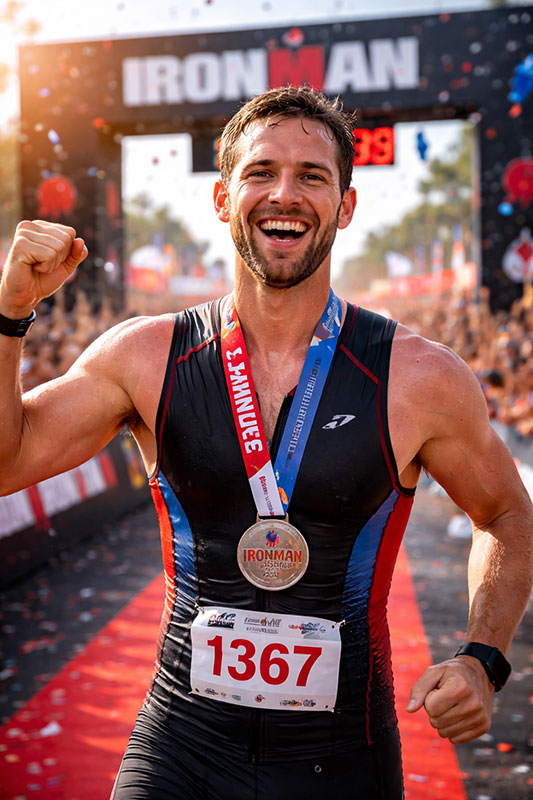
What You Get: Your Complete First time Ironman Toolkit
Whether you’re a First Time Ironman, or a triathlete for life, this is our pathway to your finish line. It’s the structure, support, and clarity you need to turn “You’ve signed up” into “You are an Ironman.”
First Time Ironman FAQ: Your Biggest Questions, Answered
You’re not alone in your questions. Here are the most common concerns we hear from athletes starting their first Ironman journey.
How many hours per week do I need to train for my first Ironman?
This is the most common question. The answer isn’t a single number, but a progression. You might start at 4-5 hours and peak at 14-18 hours; you might never get to these total hours. Our biggest concern is not the hours logged, it’s the progress made. The critical factor isn’t just the volume, but how those hours are structured. The best Ironman athletes balance stress and recovery and the best coaches not only help with this, they adapt the plan when your available time changes.
What if I miss a week of training due to work, illness, or family?
Life happens. This is exactly why static plans fail and why our Pathway uses a dynamic training plan. If you miss time, your coach recalibrates. No more worrying along about whether to ‘catch-up’ on missed sessions or what to prioritise. And certainly no prowling message boards getting 10 different pieces of advice. We simply adjust the following weeks to get you back on track safely. The goal is long-term consistency, not perfect adherence to a calendar. One missed week will not ruin your race.
I’m not a fast swimmer/cyclist/runner. Can I even finish an Ironman in time?
Absolutely. The cutoff is generous for steady, relentless forward progress. One of the first things we’ll establish is your current fitness relative to the cutoffs, and build your plan from there.
How do I know if I’m doing the workouts correctly? Am I going too hard or too easy?
This is the core value of having a coach. Every workout in your plan has a specific purpose and prescribed intensity (using heart rate, pace, or power). Your coach reviews your completed sessions to ensure you’re hitting the right zones. We turn the guesswork of “how did that feel?” into the clarity of data-informed guidance.
What should I eat during training and on race day? Can I really eat that much?
Nutrition is your fourth discipline. We build a personalised fuelling strategy that you’ll practice in training. We determine what products and timing work for your stomach, to ensure you fuel well on the bike and run. For many this will fall into the typical guidelines of 60-90grams per hour of carbohydrates, but this is very individual. The key thing we will get you to do is not only practise your race day nutrition, but practise it within key sessions we detail. By race day, your nutrition plan will be as rehearsed as your pacing.
I’m worried about the swim, especially in open water with so many people.
This is a very common fear. We address it in two ways: 1) Your swim sessions will focus on building efficiency and confidence in the pool. A well-prepared, strong and efficient swim is a much less daunting proposition. 2) We provide a clear race-day strategy for the swim start – where to position yourself, how to manage contact, and how to find your rhythm. Knowledge eliminates a huge portion of the anxiety.
What gear do I really need? I don’t have a £10,000 bike.
You need a reliable, well-fitted bike, not necessarily an expensive one. A professional bike fit is a wiser investment than a lighter frame. Beyond that, you need the basics: a wetsuit, tri suit, helmet, and running shoes. We provide a simple, prioritised gear checklist. The engine (you) is far more important than the machinery. Your coach is available to guide you entirely through the purchase of the necessary (and most often steer you away from the unnecessary throughout the process).
How do I fit all this training into my already busy life?
This is the entire premise of the Finisher’s Pathway. We don’t give you a plan and tell you to make it work. We build the plan around the life you already have. During your initial call with your personal coach, we identify the fixed points in your week (work hours, family time) and strategically place key sessions around them. Efficiency and adaptability are built-in.
What does a typical week of training look like?
Whilst this is, of course, dependent on the athlete and their individual circumstances, the process of the week is fairly common:
- Receive your week of sessions delivered via TrainingPeaks detailing what you are doing.
- Sessions are delivered through to your wearables and/ or training platforms (e.g. Garmin, Zwift, Rouvy).
- You complete your session and provide feedback on TrainingPeaks.
- Your coach feeds back on what they are seeing in the data.
- Adjustments are made as necessary to adjust intensities or move sessions as needed during the week.
This continuous loop of planning, execution, and feedback ensures you’re always training with purpose and protects you from overtraining or uncertainty.