
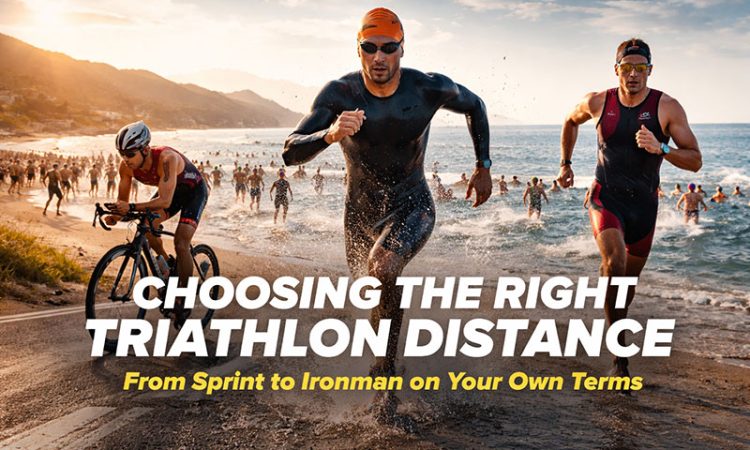
Choosing the Right Triathlon Distance, remember when getting into triathlon meant joining a club, buying a racing bike you couldn’t afford, and slowly working your way up the ladder over years? Sprint, then Olympic, maybe a half… and only the truly dedicated ever whispered the word “Ironman.”
The modern triathlon scene has changed. Today, inspired by social media, stories of resilience and the lure of the ultimate challenge, athletes are signing up for 70.3 or full Ironman races as their very first triathlon. The traditional path to long-distance racing hasn’t disappeared, but there’s a new, daring alternative route: starting at the deep end.
If you’re interested in knowing which path you should be taking, this guide is for you. We’ll break down how to pick the race distance that suits you best, what key questions you need to ask yourself and what training for the different events needs to look like.
The Allure of the Big Day: Why 70.3 and Ironman Call to Us
Let’s start with a raw fact: “I’m training for an Ironman” carries a certain weight. For many it’s a monumental life goal and a challenge that extends far beyond sport. The same is true for the 70.3 (Half Ironman), a massive achievement that commands respect.
The appeal is clear:
- The Transformational Journey: The process changes you. The discipline, resilience, and self-knowledge gained over 6–12 months of preparation are often as valuable as the medal. As we often say to athletes we coach: You become an Ironman in the dedication in training, the medal just validates the end of that journey.
- A Clear, Singular Goal: In a busy world, having one big athletic goal simplifies your focus. Every swim, bike, and run has a clear purpose.
- The Community & The Spectacle: These events are festivals of human potential. The energy is electric, and the shared struggle creates an instant bond with thousands of others.
Gone are the days when these distances were reserved for veteran triathletes. Now, they are entry points for committed beginners with a “why” that’s bigger than any pre-requisite race. The question isn’t “Are you qualified?” but “Are you ready to build the process to get there?”
Breaking Down the Distances: It’s Not Just About Going Longer
Choosing a distance isn’t just about adding miles. The nature of the challenge shifts significantly.
Sprint & Olympic: The Skill & Speed Focus
- The Dynamic: These races require a large degree of technical proficiency and are far more intense. The swim is a higher percentage of the total race time, making competency here a non-negotiable. Transitions are fast, and the pace is high from start to finish.
- The Swim Factor: An Olympic distance swim (1500m) is a challenge for many new swimmers – both mentally and physically. It requires specific fitness and comfort. If you’re not a confident swimmer, this can feel like the biggest hurdle.
- Perfect For: The time-conscious athlete, those wanting to develop top-end speed, or anyone who wants to test the triathlon waters with a demanding but logistically manageable event.
70.3 & Ironman: The Sustained Energy & Systems Puzzle
- The Dynamic: Here, pacing, nutrition, and resilience take centre stage. It’s a marathon, not a sprint (quite literally). The challenge moves from pure athleticism to one of strategic energy management and mental fortitude.
- The Swim Factor: While still crucial, the swim becomes a smaller percentage of your overall day. For a strong cyclist/runner, a moderate swim time is less damaging. However, the wetsuit question becomes critical.
Your Secret Weapon (or Hindrance): The Wetsuit Decision
This is one of the most overlooked factors in race selection. A wetsuit-legal swim provides significant buoyancy and speed, making the distance more accessible for most. A non-wetsuit swim is a pure test of swimming fitness and technique. A race which is certain to have a wetsuit-legal swim (and this requires a fair bit of research) should be approached differently to one where there is a chance of wetsuits being ruled-out.
Our advice? If you’re new to triathlon or not a confident swimmer, prioritise finding a wetsuit-legal race for your target distance. It’s a gentler introduction that lets you focus on the overall experience, not survival. Save the non-wetsuit challenge for your second go-around.
The Ultimate Question: Can You Fit Ironman Training Into Your Actual Life?
This is the heart of the matter. The old fear: Ironman training is a 20-hour-a-week black hole that consumes your life.
The modern reality: It’s about intelligent processes, not just endless hours. We recently coached a senior client (a head of marketing for a well-known UK brand and mum of two young children) to her first Ironman finish. She didn’t quit his job or abandon her family. We built a system based on:
- Ruthless Priority: Sessions that had clear, understood aims.
- Adaptive Flexibility: Clear communication between athlete and coach, a true understanding of the life and training demands, a focus on progress not time accumulated.
- Recovery as Part of the Plan: A relentless focus on ensuring that recovery was prioritised to allow sessions (when they happened) were maximised.
Her training didn’t fit into her life; it was woven into the fabric of it. That’s the key shift.
So, How Do You Choose? Ask Yourself These Questions:
- What’s Your “Why”? Is it a personal transformation story (leaning toward 70.3/Ironman) or a desire to master the sport’s raw speed (leaning toward Sprint/Olympic)?
- Be Honest About the Swim: Where is your confidence? Let this guide your first race choice and wetsuit requirement. This decision effects how you train for the race and how you will feel in the build up.
- Audit Your Life Realistically: Look at the next 6–12 months. Do you have the capacity to commit 6–10 hours per week consistently (for a 70.3) or 10–16 hours (for Ironman), with a system to manage it? These hours don’t need to be every week, but they do need to happen frequently.
- Seek a Guiding System, Not Just a Plan: A generic plan will break against the rocks of your real life. Your success hinges on having a coachable system: principles for adaptation, not just a rigid spreadsheet.
The New Pathway Starts With Your Decision
The beauty of modern triathlon is that the choice of direction is yours. You can follow the traditional, incremental climb, or you can point yourself at the mountain and learn to climb on the way up.
The right distance is the one that dares you to grow, but doesn’t set you up to fail. It’s the challenge that fits into the life you have, while helping you build the life, and the athlete, you want to become.
Ready to map your challenge to your life? Our coaching is built on designing these sustainable, high-achievement processes for athletes at every starting point.